
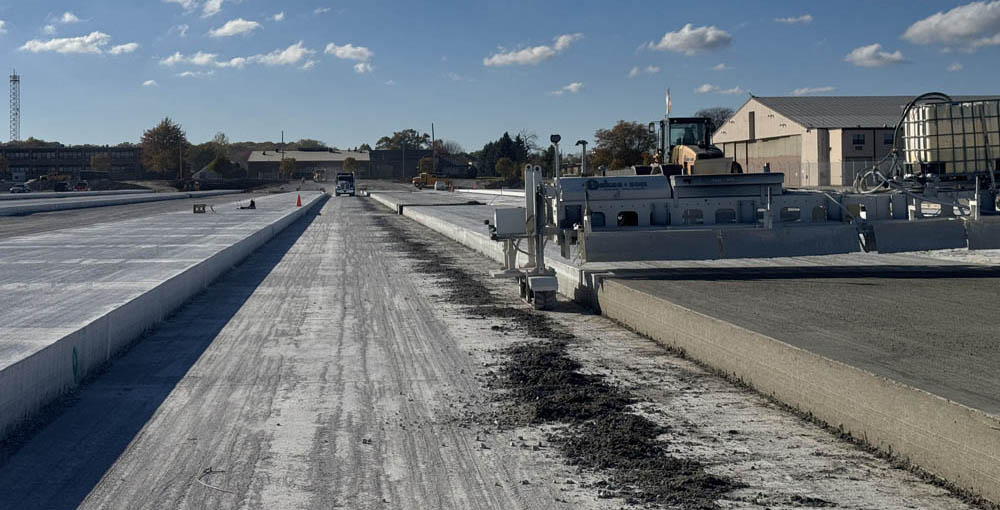
At A.W. Oakes & Son, we often say that "versatility is our strength," but few projects demonstrate that as clearly as the new cargo facility currently underway at General Mitchell International Airport (GMIA). This massive undertaking involves a complex blend of private development for Crow Holdings and a significant federal component, requiring a level of coordination and technical rigor that few firms can match.
Navigating Federal and Private Requirements
Managing a project with both private and federal stakeholders requires more than just heavy equipment; it requires a sophisticated approach to communication and sequencing.
“Balancing private and federal components really comes down to ownership and how each side is managed, but our approach stays the same,” says On-Site Coordinator & Quality Control Matt Fricker. “We prioritize strong relationships and clear commitments across all parties. When management sets crews up in the right position with the right information, the field can execute efficiently. That alignment is what keeps a project of this scale on schedule.”
The Science of the Tarmac: Built for Heavy-Duty Demands
A cargo facility is only as good as the foundation it sits on. To handle the extreme stresses of heavy-duty cargo loads and constant use, the Oakes team begins the process long before the first yard of concrete is poured.
The success of the tarmac depends on:
- Subgrade Stabilization: Ensuring the ground is properly compacted, proof-rolled, and corrected to provide a solid foundation.
- Controlled Aggregate Base: Placing and compacting base layers in controlled lifts to achieve required densities.
- Real-Time Quality Control: Our internal concrete testing services work alongside the crews to verify material quality during placement, allowing for immediate adjustments.
Precision Under Pressure: The P501 Standard
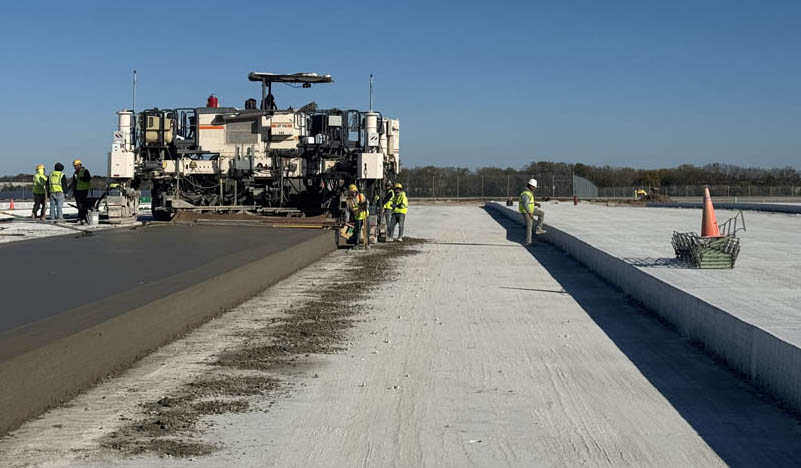
Paving a facility of this scale is an endurance feat. For three weeks, sun up to sun down, our crews maintained strict tolerances for smoothness, thickness, and joint construction.
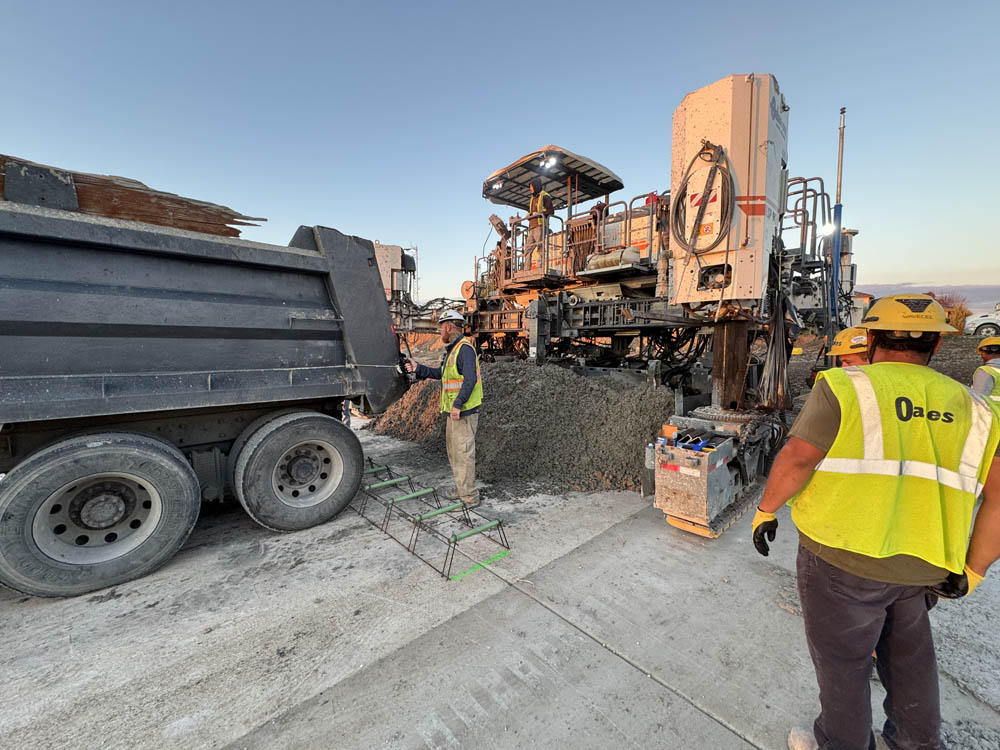
Craig Stocks, Concrete Paving Superintendent, attributes this success to the unique resources Oakes brings to the table. “I feel extremely fortunate because of the resources I am allotted. Our in-house Quality Control lab for concrete testing and our ownership of a mobile central mix batch plant are key. These tools allow us to control the start and finish of the concrete placement process, which is crucial on a major project like this.”
By utilizing state-of-the-art paving equipment guided by total station technology, the team isn't just meeting standard specs—they are exceeding the stringent FAA "P501" guidelines.
A Proud Milestone for the Oakes Team
For the team on the ground, the reward is in the results. “From a coordination and quality control perspective, the most rewarding moments came at the end of those long paving days,” says Fricker. “Seeing the finished slabs and the precision achieved by the paving crew after three weeks of continuous production is a major accomplishment and something our team takes a lot of pride in.”
As we continue progress at GMIA, the Crow Holdings facility stands as a landmark project for A.W. Oakes & Son—a testament to what happens when elite technology meets an unwavering work ethic.
